RELATED
Submission
Canadian Union of Postal Workers (CUPW) brief submitted to Ontario's Workforce Recovery Advisory Committee (OWRAC) - July 2021
July 30, 2021
The Canadian Union of Postal Workers
The Canadian Union of Postal Workers (CUPW) represents 60,000 workers, including many performing courier work in the private sector. We have defended the interests of postal and other workers since 1965. We have fought hard for fairness for workers. Most recently, after a 20-year battle, we obtained pay equity for Rural and Suburban Mail Carriers (RSMCs), who were incorrectly considered independent contractors prior to joining CUPW.
CUPW is pleased to provide this submission to the OWRAC in order to inform the Committee on the best way forward to support workers in the gig economy, ensuring that they benefit equally from Ontario Employment Standards, and increased security as workers and providers of necessary services to Ontarians.
Introduction
Updating labour policy to ensure that gig workers are given full and equal rights under the law is a pillar that best ensures the vibrancy of the Ontario economy. Our Union has fought for the rights of gig economy and other precarious workers; we are well-placed to state the case for changes to policy and practices that will provide these workers with fair pay and protections. In the wake of the COVID-19 pandemic, now is the moment to opt for justice for frontline workers who are billed “heroes” but who lack the basic protections of regularized employment status, benefits and fair labour practices.
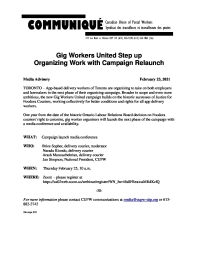
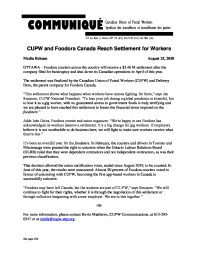
Court decisions the world over, including in the US, Spain, South Korea and the UK, have stipulated that gig workers are not independent contractors and deserve rights as employees. In Ontario, recent decisions have moved in the same direction. Most recently, the Ontario Labour Relations Board decided in favour of gig workers. Its decision went against the position of Foodora (an app-based food delivery company), that asserted that couriers were independent contractors, which granted Foodora workers the right to unionize (Canadian Union of Postal Workers v Foodora (2020)).
We propose to focus on three separate, but interlinked, elements that CUPW considers essential to fair labour practice: the refusal to include a niche, third category of worker; the establishment of a new statutory definition of both employee and independent contractor in the Employment Standards Act, including the introduction of a reverse onus for employers; and access to fair and standard labour practices.
No Niche Third Category
Uber Canada’s recent proposal (Flexible Work +) is the most recent example of app-based companies attempting to create a sub-category of employment that would enshrine their exploitative model into law, and allow them to avoid their responsibilities as employers. This proposal aims to create a low-rights, low-expense model of employment for app-based employers, thereby threatening the stability and liveability of gig workers. It also incentivizes employers in other industries to move towards an app-based model as a way to cut costs which will further erode hard-won labour standards; standards that protect workers from unfair labour practices, including an absence of universal benefits such as sick leave, paid holidays, parental leave, health and safety protections, and the ability to contribute to EI and to CPP. We urge the Committee to reject any niche, or third category of worker, and instead recommend that gig workers be deemed employees under the Employment Standards Act, thereby granting them full access to the rights and protections enjoyed by every other worker in Ontario.
New Statutory Definitions and the Reverse Onus
The clearest way to ensure that gig workers are able to access what they need to make ends meet across Ontario is to end the misclassification of those workers. To that end, CUPW calls on the Government of Ontario to: introduce new statutory definitions of both employee, and independent contractor in the Employment Standards Act (ESA); make the employee designation the default status of all workers under the law and; introduce a multi-factor test that would shift the onus onto employers to prove that a worker is not an employee, but rather an independent contractor. We take some guidance from California’s Assembly Bill 5 (AB5).
A statutory definition of "employee" must encompass any person who performs labour or supplies services for monetary compensation, as well as a presumption of employee status unless the hiring entity can establish that the person is not an employee as set out below.
A clear statutory definition of "independent contractor" would be structured around four cumulative conditions:
- The person is free from the control and direction of the hiring entity in connection with the performance of the work, both under the contract for performance of the work and in fact;
- The person performs work that is outside the usual course of the hiring entity’s business;
- The person is customarily engaged in an independently established trade, occupation or business of the same nature as the work performed; and
- The person has the risk of profit and the risk of loss.
In combination with the two definitions above, there should be a statutory prohibition on misclassifying an employee as “not an employee”. Using the test above, the onus must be on the employer to demonstrate that the worker is not an employee.
We know that misclassification has been the cornerstone of the app-based model of employment – with companies washing their hands of basic responsibilities toward their workers—and we denounce this practice. Rectifying these lacunae would afford app-based workers the basic protections in the employment standards framework, and would disincentivize the gigification of other industries with employers seeking to rid themselves of their responsibilities toward workers.
The definitions and test above are the simplest, clearest and most practical tools to determine an employment relationship. Utilizing a multi-factor test in that determination is also well established in case law. Most recently, in Canadian Union of Postal Workers v Foodora 2020, the Ontario Labour Relations Board applied a multi-factor assessment to determine the employment status of food delivery couriers, affirming their status as dependent contractors, and therefore employees. But in this case, the onus was on the workers to prove their status. We must shift that onus to the employers, who hold the majority of power in the employment relationship.
Obtention of Benefits Accorded to Other Workers
As the situation currently stands, gig workers have been unjustly, and we would argue unlawfully, carved out of the definition of employee. This discriminatory practice renders gig workers’ ability to earn a fair living practically non-existent. CUPW urges the Committee to consider a number of issues.
App-based employers have long vaunted the merits of their employment model by arguing that gig workers benefit from flexibility. In reality, the opposite is true: it is the employers who benefit from flexibility. Swings in consumer demands, combined with algorithms completely outside the workers’ control, determine when they will work and how much they will earn. If they do not follow those dictates, they struggle to make anything approaching a minimum wage, let alone a living wage. That, coupled with an ever-increasing labour pool, has led to a steady decline in pay. When so-called flexibility is promised in exchange for fair pay, transparency, health and safety and job security, this is tantamount to a predatory scheme on the part of app-based employers.
It is critical, for these workers, and all workers, that full protection and employment rights be accessible to them, including the right to organize, join a union, and negotiate their working conditions. On the issue of the right to join a union, it is important to note that the dependent contractor status contemplated under the Ontario Labour Relations Act is inadequate. Because there is no statutory definition under the ESA, employers are legally permitted to offer less than the minimums afforded under the Act. This is unacceptable. Any instance of collective bargaining should at least start at the minimums prescribed under the Act.
CUPW advocates for gig workers to benefit from all the same rights as other employees. They must have access to wages that reflect actual work accomplished, health and safety regulations, sick leave, parental leave and protection from unjust discipline, dismissal, and harassment. Moreover, these workers must be able to receive Employment Insurance benefits, as well as Canada Pension Plan earnings that include employer contributions. We reiterate: the simplest and most effective way to ensure app-based workers access to all the benefits that workers traditionally accepted as employees receive, is to end the issue of misclassification through enacting the steps outlined in the New Statutory Definitions… section above.
Conclusion
In closing, members of the OWARC Committee, we ask that you ensure that app-based workers not be relegated to a second-class category of worker, barely able to scrape together a living wage. Pandemic lockdowns and restrictions have shown that Ontarians benefitted from their services, at the risk of these workers falling ill, without the safety net of paid sick leave. It is high time that these workers be treated fairly by benefitting from the same labour protections as other workers.
The systematic misclassification of workers used by app-based employers is the major path to their profit margins. But a business model that is based on mistreating workers should not be welcome in Canada. We must draw a line: we cannot sacrifice our minimum labour standards and the health of our most vulnerable workers to the so-called convenience of the clientele or to the profit share of gig employers. This cannot be done at the cost of a living wage and labour rights for those who perform these services.
References
Canadian Union of Postal Workers (CUPW) (2021, April 30). “Brief submitted to Employment and Skills Development Canada Consultation on the New Realities of Working Canadians”. Ottawa. Unpublished.
Canadian Union of Postal Workers v Foodora Inc., (2020), CanLII 16750, OLRB Case No: 1346-19-R.
Ontario (2000). Employment Standards Act. , 2000, SO 2000 c 41.
California. CA AB5 | 2019-2020 | Regular Session. (2019, September 18). LegiScan. Retrieved July 29, 2021, from https://legiscan.com/CA/bill/AB5/2019.